
Kingdom Casino Reviews, Complaints and Reputation Signals
 Available in GB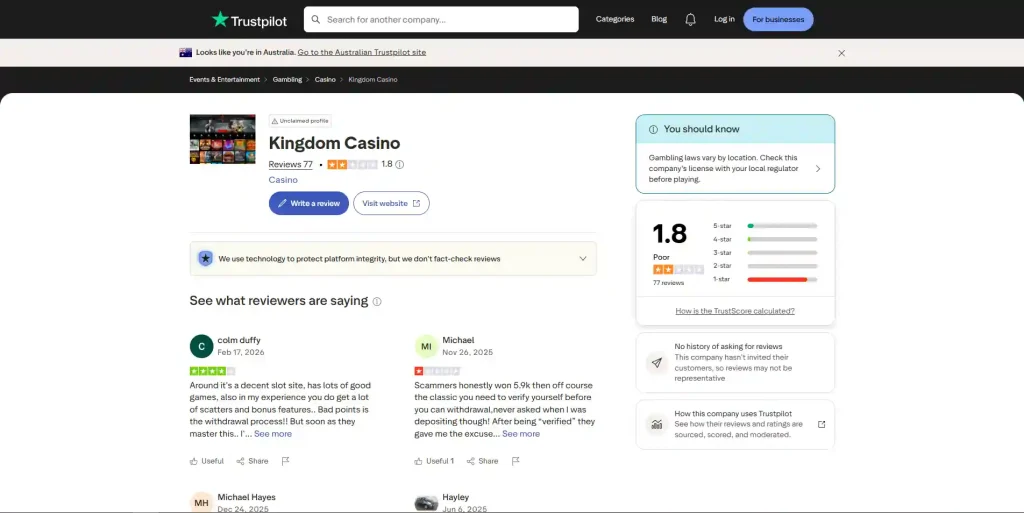
What the current review platforms show
Casino Guru’s current KingdomCasino.io review displays a Safety Index of 1.8 out of 10 and labels it “Very low”. That score is Casino Guru’s own editorial metric, not a regulator rating. The platform says its calculation considers matters such as terms and conditions, estimated casino size, complaints, blacklists and other factors. It therefore represents one review publisher’s structured risk assessment rather than an official determination.
The same Casino Guru page currently shows 25 complaints in its safety breakdown: 11 unresolved, 6 resolved and 8 rejected. That mix is important. The unresolved cases are a negative signal because the platform says some disputes could not be brought to a satisfactory conclusion. The resolved and rejected cases also matter because they show why counting complaint headlines alone can be misleading. A complaint can end with the player receiving a resolution, or the reviewer can decide that the operator acted within the terms it assessed.
Trustpilot presents a different kind of evidence. Its current Kingdom Casino profile shows a TrustScore of 1.8 out of 5 across 77 reviews. The visible distribution is heavily negative: 86% of reviews are 1 star, while 9% are 5 star, 4% are 4 star and 1% are 3 star. Trustpilot also shows 41 reviews in the last 12 months, so the score is not based only on old feedback.
Trustpilot also currently attaches a platform-quality warning to the kingdomcasino.io profile: a breach-of-guidelines notice on the page and a statement that a number of fake reviews have been removed. That warning is a Trustpilot moderation signal about the profile itself, separate from the aggregate 1.8-out-of-5 figure. It does not invalidate every individual review, but it does mean the raw star distribution should be read with an awareness that platform moderation has already intervened on this profile.
These two platforms use different methods. Casino Guru mixes editorial analysis and complaint handling into its Safety Index, while Trustpilot mainly aggregates customer reviews under its own moderation system. The fact that both currently display low scores, and that Trustpilot additionally posts a guideline-breach warning on the profile, is therefore more informative than either number in isolation, but it still does not turn every individual review into a verified fact.
The recurring complaint themes
The clearest repeated theme is withdrawal friction. Recent Trustpilot reviews include claims about long processing periods, rejected withdrawals and balances being disputed after a player requested payment. Casino Guru’s complaint archive also contains cases involving delayed withdrawals, confiscated winnings, account closures and disputes about whether terms were breached. These are reports made by players and case summaries prepared by the review platform. They should be read as a pattern of reported experiences, not as proof that every withdrawal at Kingdom Casino will fail.
A second recurring theme is verification. Some reviewers say they encountered KYC checks around the point of withdrawal, or that verification took longer than expected. Identity verification can be required, particularly around withdrawals. Exact document requirements and processing times should be confirmed in current primary material because they can change. Complaints can show where friction is being reported, but they are not a reliable substitute for the operator’s current verification rules.
A third theme concerns account closure or alleged terms breaches. Several complaint records describe players being told that their accounts or withdrawals were affected because the casino considered a rule to have been broken. In some cases, users dispute the explanation or say it was not specific enough. Again, the editorially safe conclusion is not that the casino always closes winning accounts. The conclusion is that terms enforcement is a recurring dispute topic in current third-party records, so players should preserve copies of the terms, bonus conditions and transaction history relevant to their session.
Bonus-related disputes appear within that pattern too. A player may believe wagering has finished while the operator later relies on a restricted-game or maximum-bet clause. Casino Guru has at least one case where it rejected the complaint after concluding that a player had broken the stated maximum-bet rule while a bonus was active. That example is useful because it demonstrates that negative complaint volume cannot simply be treated as a list of proven operator failures.
Why individual reviews need careful weighting
Review sites have selection bias. People who experience a serious problem are often more motivated to post than customers whose deposit, play and withdrawal were uneventful. The reverse problem also exists: businesses or interested parties can try to inflate ratings with promotional or inauthentic feedback. A sensible reputation check therefore looks for recurring themes, dates, platform moderation, complaint outcomes and consistency with other independently verifiable facts.
Trustpilot’s current page includes both strongly negative and positive reports. Some recent reviewers describe slow withdrawals or unresolved problems; others say they eventually received money, report improved withdrawal speed, or describe the site positively. That balance does not erase the low aggregate rating, but it shows why the page should not quote a handful of extreme reviews and present them as the whole customer base.
Casino Guru likewise separates complaint outcomes. An unresolved case carries a different evidential weight from a rejected case, because the platform’s own complaint team has reached different conclusions. Its Safety Index also includes factors beyond user comments. For decision-making, this makes the platform-level assessment more useful than copying the most dramatic accusation from a complaint thread.
Dates matter as well. Casino operations, ownership, payment processes and licence records can change. This site separates the current kingdomcasino.io operation from older legacy-domain material and gives priority to fresh 2026 signals. Readers should do the same when checking reviews themselves: verify that the complaint is about the current domain and current operator before using it to judge today’s service.
Withdrawal complaints: what to check before depositing
If withdrawals are the main reputation concern, the best response is practical due diligence before money is committed. Read the current cashier and withdrawal terms while logged out if they are publicly available, then save the version that applies when you deposit. Look for withdrawal limits, pending periods, required verification steps, method restrictions and any rules that can affect bonus-derived winnings. Do not rely on a review site’s quoted limit as if it were the operator’s current contract.
Keep records of deposits, bonus activation, wagering progress, verification submissions and withdrawal requests. If a disagreement occurs, a dated record makes it easier to establish what happened than relying on memory. It also helps a complaint mediator distinguish a payment delay from a terms dispute or an incomplete verification step.
The detailed payout checks guide explains the mechanics and the limits of what can currently be verified. Exact withdrawal speeds, fees or numeric limits are not stated without current primary support. Reputation data can tell you that withdrawals are a recurring complaint theme, but it cannot safely supply contractual numbers.
KYC complaints: separate the requirement from the reported delay
Identity checks are not unusual in online gambling, and the existence of KYC at Kingdom Casino is not inferred only from complaints. Current evidence supports the statement that verification can be required, especially in connection with withdrawals. What remains uncertain is the exact document list and how long a particular review will take.
That distinction matters when reading negative feedback. A review saying “I was asked to verify before withdrawal” is not, by itself, evidence of improper conduct. A pattern of users reporting long or repeated verification requests can still be relevant to the expected customer experience, but the allegation and the verified underlying requirement are different categories of evidence.
The verification process guide keeps that boundary clear. Current primary material should be used for exact document or timing requirements.
Reputation evidence is not licence evidence
Reviews and complaints should not be used to determine whether a casino is licensed in a particular jurisdiction. Licence status needs regulator or register evidence. No UK Gambling Commission licence was verified for Kingdom Casino, kingdomcasino.io or Softon Ltd in the checked public register. That is a separate, independently checked fact and is more important to a British reader than whether a reviewer calls the casino “legit” or “a scam”.
The current offshore licence evidence is covered on the licence details page. The broader trust overview connects licence jurisdiction, operator identity, local protection and reputation without treating one signal as a substitute for the others.
This separation is especially important with severe accusations. A user can describe an experience in very strong language, but that language should not be repeated as a factual conclusion without supporting evidence. Where a regulator has made a finding, the finding can be reported. Where only a user allegation exists, it stays attributed to the user or to the complaint platform.
A simple evidence hierarchy for reading casino reviews
For regulatory status, start with the regulator’s register. For contractual questions such as bonus rules or withdrawal limits, start with the operator’s current terms or cashier pages. For service-quality patterns, compare recent independent review platforms and complaint outcomes. For a single player’s story, treat it as one data point unless it is corroborated by records or a formal decision.
This hierarchy prevents two common mistakes. The first is dismissing every complaint because it is “only a review”. Repeated complaints about the same stage of the customer journey can be a meaningful warning signal. The second is assuming that repetition proves the allegation. Ten similar posts can still share the same misunderstanding, or can all concern an old version of the terms.
The strongest reputation conclusion is therefore calibrated: Kingdom Casino currently has materially negative third-party reputation signals, particularly around withdrawals, KYC and account or terms disputes. Those signals justify extra caution and extra documentation. They do not establish that every complaint is true or predict the outcome of every individual account.
How much weight UK players should give Kingdom Casino review signals
UK players should give the current reputation evidence substantial weight because two prominent independent platforms presently show weak aggregate signals, and specialist complaint records contain multiple unresolved disputes. The practical implication is not to adopt the language of the most hostile review. It is to raise the standard of evidence you require before depositing: verify the licence position, read the current terms, understand verification requirements and retain records of the payment journey.
The current Trustpilot score and Casino Guru Safety Index are snapshots, not permanent labels. They can change as new reviews arrive, complaints are resolved, policies change or platform methodologies are updated. Because these figures can change, current platform values should replace older figures rather than being layered on top of them.
For a complete decision, combine the reputation signals with the main Kingdom Casino review, the withdrawal guide, the KYC page and the licence check. Reputation is most useful when it tells you where to look more closely, not when it substitutes for primary evidence.
Is Kingdom Casino Legit? Trust and UK Player Protection
Prepared by the Kingdom Casino editorial staff.